


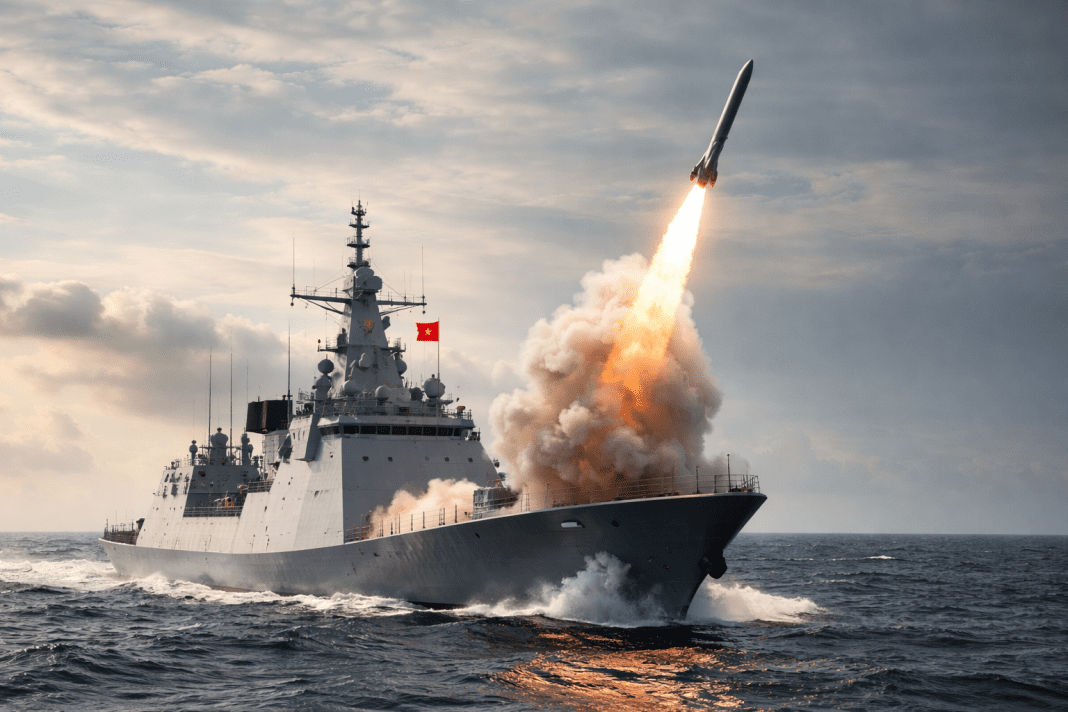


China released rare footage of its YJ-20 hypersonic missile launched from a Type 055 destroyer, striking targets at extreme speed. The “carrier-killer” display signals growing Chinese naval power amid Taiwan tensions and rising Western naval activity.
Rare Footage Reveals a Major Naval Weapons Test
The newly released footage shows a missile launch sequence that China has never officially shown before. The missile is fired from a vertical launch system using a cold-launch method. In this process, compressed gas pushes the missile upward before the engine starts. This reduces stress on the ship and allows for safer launches.
Multiple camera angles capture the moment the missile leaves the ship, climbs rapidly, and then descends at high speed toward its target. The target is struck and destroyed, confirming the missile’s intended role against large surface vessels. No information was provided about the test location, range, or speed, but the launch was described as a “finalization test.” This term is often used to describe a stage close to mass production or operational use.
U.S. expands hypersonic weapons programs as China and Russia deploy advanced missile systems
The launch platform, the Type 055 destroyer, is one of the most powerful surface warships in China’s navy. Due to its size and advanced systems, it is often classified by other countries as a cruiser rather than a destroyer. The ship carries a large number of missiles and has strong radar and command systems, making it a key asset in modern naval operations.
By showcasing the missile from this platform, China highlighted the combination of advanced ships and advanced weapons working together. This pairing significantly increases the ship’s ability to strike targets far away and defend itself in contested waters.
What Makes the YJ-20 a ‘Carrier-Killer’
The YJ-20 hypersonic missile is designed to fly at extremely high speeds, well above five times the speed of sound. Unlike traditional anti-ship missiles that skim close to the sea surface, this missile follows a very different path. It climbs high and then dives down toward its target at a near-vertical angle.
This steep attack profile makes the missile harder to detect and intercept. Most ship-based defense systems are built to counter threats coming in horizontally, not from above at extreme speed. As a result, defending ships have far less time to react.
Another key feature of the YJ-20 is its unique shape. The missile uses a biconic, or dual-cone, design. This shape creates shock waves during hypersonic flight that protect the missile from intense heat and pressure. These shock waves also help keep the missile’s control surfaces working properly even at very high speeds.
Because of this design, the missile can make sharp turns and evasive moves while still traveling at hypersonic velocity. This combination of speed, maneuverability, and steep descent greatly increases its striking power. Even without relying heavily on explosives, the sheer kinetic energy of the impact can cause massive damage to large ships.
The missile is believed to be capable of targeting high-value naval assets, such as aircraft carriers and large amphibious ships. Its reported range, estimated to be between 1,000 and 1,500 kilometers, allows it to strike targets far beyond the reach of many traditional naval weapons.
Strategic Message Amid Regional and Global Tensions
The public release of China’s YJ-20 missile launch footage is seen as more than a routine weapons test; it serves as a strategic signal. China rarely shares detailed visuals of advanced military systems, especially hypersonic weapons, indicating confidence in the missile’s readiness. The timing of the release comes amid high tensions in the Taiwan Strait and surrounding waters, where Western navies, including the United States and allies, regularly operate. Aircraft carriers form the backbone of these naval forces, making anti-carrier weapons like the YJ-20 a critical part of modern naval strategy.
China has been rapidly expanding its hypersonic weapons program across multiple platforms, including ships, submarines, and aircraft. The YJ-20 fits into this broader push to create layered strike capabilities capable of challenging advanced naval forces. First revealed during a major military parade alongside other hypersonic systems, the missile has since shown rapid progress toward operational deployment. The recent footage suggests it may be moving from testing to active service.
Additionally, China’s advances in missiles and aircraft, coupled with growing arms market influence, have heightened concerns among rival powers about shifting military balances in Asia and the Middle East. By showcasing the YJ-20 on a frontline warship, China emphasized its ability to combine speed, precision, and long-range strike power in modern naval warfare, sending a clear message to regional and global audiences.