


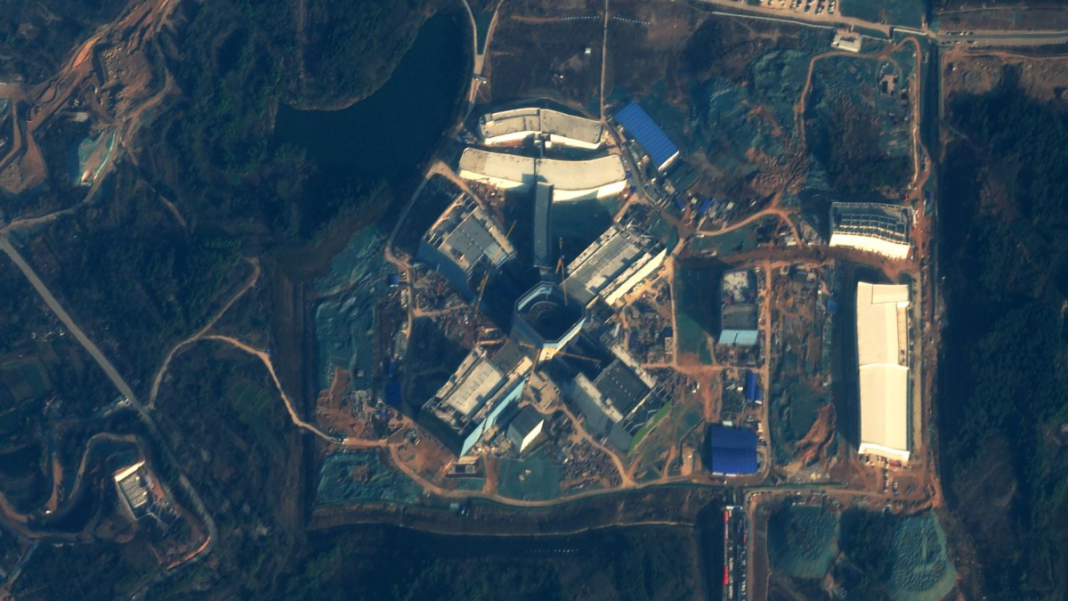


Satellite images show major construction at secret nuclear weapons facilities in southwest China. The images reveal new buildings, underground bunkers, and industrial infrastructure linked to hazardous nuclear work. Captured between 2022 and 2026, the imagery shows steady expansion at two sites in Sichuan Province. Analysts say the activity points to a growing nuclear weapons program.
What the Satellite Images Reveal in Sichuan
The construction activity is focused in Sichuan Province, a remote region with rugged terrain and limited public access. One site located in a valley shows newly built bunkers covered with thick earth and reinforced barriers. These structures are designed to hide sensitive work and contain powerful explosions.
A new complex at the site includes an extensive network of pipes connecting multiple buildings. Analysts say such piping is typical of facilities that handle hazardous or highly sensitive materials. These systems can move gases, liquids, or cooling agents needed for dangerous industrial operations, suggesting activity beyond simple storage or routine use.
China quietly deploys over 100 DF-31 nuclear missiles capable of striking the U.S. and U.K.
Engineers have built the bunkers into hills and natural rock to add protection. Satellite images also reveal ramparts and controlled entry points that restrict movement and visibility. Analysts believe the site likely supports high-explosives testing, a critical step in nuclear weapons development that helps refine how explosive forces compress nuclear material evenly.
Activity at a Double-Fenced Nuclear Complex
Satellite images show another location in Sichuan as a heavily secured facility surrounded by double fencing. A tall industrial structure stands at the center of the site, with a ventilation stack rising about 360 feet into the air. Engineers typically build such tall stacks to release heat and filtered air from tightly controlled processes inside the building.
The structure’s design indicates use for advanced nuclear-related manufacturing. Analysts say the layout closely matches facilities in other countries that produce plutonium components for nuclear weapons. These components, often called warhead cores, play a central role in triggering a nuclear explosion.
Pentagon warns China has loaded over 100 ICBMs as nuclear expansion accelerates
Recent images show that the facility has undergone upgrades over time. Crews have added new vents and heat-dispersion features. These changes suggest increased activity inside the building, possibly involving higher temperatures or more intensive production processes.
Satellite images also reveal additional construction near the main structure. New buildings, support areas, and access roads point to expanded operations and a growing workforce. The double fencing and controlled layout indicate that security remains a top priority at the site.
Why These Developments Matter
The satellite images provide rare insight into activities that are usually hidden from public view. Because nuclear weapons programs are highly secretive, satellite analysis has become one of the few ways to monitor changes and assess their scale. In this case, the steady growth seen over several years suggests a sustained effort rather than a short-term project.
The expansion of these facilities shows that China is investing heavily in the infrastructure needed to support nuclear weapons development. This includes testing, refinement, and production work that requires specialized buildings and safety systems. The remote location in Sichuan adds another layer of secrecy, making outside observation difficult without advanced imaging technology.
Beijing’s nuclear gamble — China’s 14,000-container mega ship dares the world with molten salt power
The findings highlight how modern satellite tools can reveal changes that would otherwise go unnoticed. By tracking construction patterns, materials, and layout designs, analysts can form a clearer picture of what is happening on the ground. In this case, the images point to a significant increase in nuclear-related capabilities within China, centered far from its coastal cities and public military sites.
The developments in Sichuan reflect broader changes in how major powers manage and expand their strategic infrastructure. While much of the work happens quietly and behind closed doors, satellite imagery continues to shed light on activities that have global importance.