


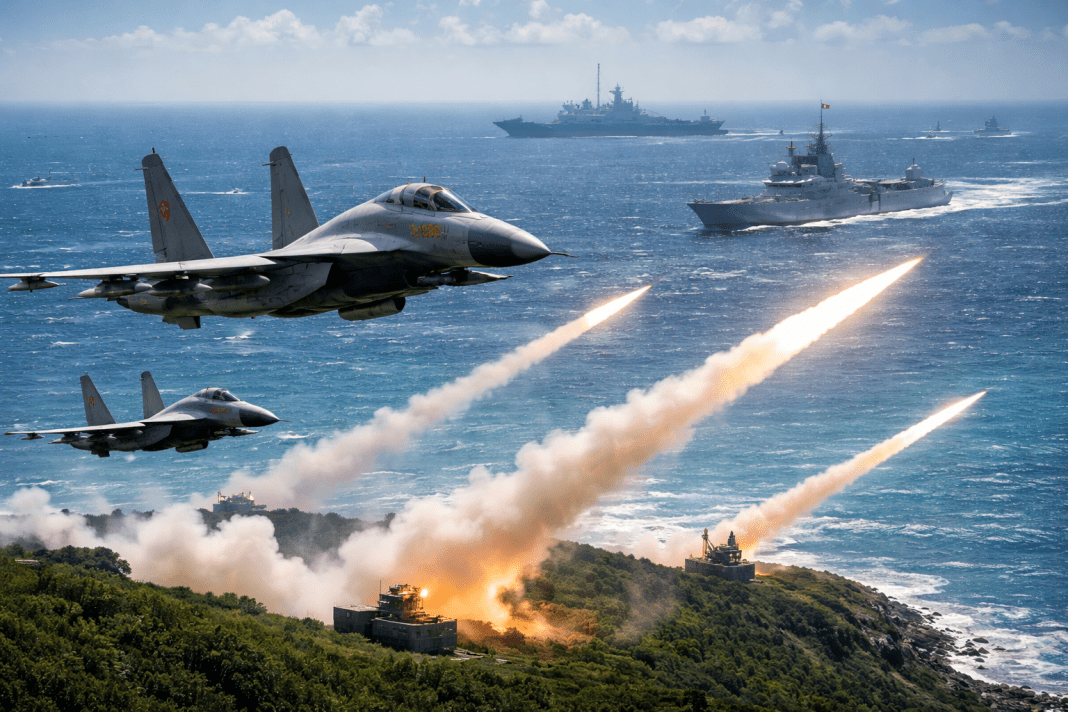


China has launched new large-scale military exercises in the “middle areas” of the Taiwan Strait, signaling a sharp escalation in pressure on Taiwan. The move comes amid rising diplomatic tensions with the United States and Japan. The drills are being closely watched in the region as a demonstration of China’s military strength and readiness.
China Kicks Off Large-Scale Military Drills in Taiwan Strait
According to Chinese state media, the People’s Liberation Army (PLA) is deploying fighter jets, bombers, and unmanned aerial vehicles. Long-range rocket strikes are also part of the exercises. The drills are designed to practice targeting mobile ground objectives. They also test the military’s ability to conduct precise attacks on key locations.
The Taiwan Strait is a strategic waterway. It separates Taiwan from mainland China and serves as a vital route for international shipping. The region has long been a hotspot for military activity. The latest exercises mark another step in Beijing’s ongoing display of military power. By conducting drills in the middle areas of the Taiwan Strait, China is emphasizing its control over this important maritime zone.
China warns of New Zealand naval patrol in Taiwan Strait citing regional risks
Rising Regional Tensions Amid US Arms Sale and Japan Concerns
The latest drills come shortly after the United States approved a major arms package for Taiwan worth USD 11.1 billion. If Congress passes the proposal, the United States would authorize the largest weapons sale ever for the island. China has strongly condemned the decision and accused the U.S. of encouraging forces that support Taiwan’s independence.
Chinese officials said the arms sale sends a “gravely wrong signal” to Taiwan’s independence supporters and claimed it could destabilize the region. They view the military drills as a direct response to the arms sale, sending a clear warning to both Taiwan and its international supporters.
China Warns Germany Over Provocative Taiwan Strait Passage
Meanwhile, diplomatic tensions between China and Japan are also intensifying. Japan has taken steps to bolster its military presence near Taiwan, including plans to deploy mobile radar units to monitor Chinese military activities in the Taiwan Strait. Chinese officials have strongly opposed these measures, calling them a threat to regional stability.
China has accused Japan of expanding its military deployments near Taiwan to find a pretext for further military build-up. Officials also raised concerns over statements made by Japanese political leaders about potential contingencies involving Taiwan. These tensions highlight the growing strategic competition in the region and the sensitivity of the Taiwan Strait as a flashpoint.
China’s Increased Military Activity Around Taiwan Strait
Since 2022, China has steadily ramped up its military activities near Taiwan. The escalation followed high-profile visits by foreign officials to Taiwan, which Beijing views as a challenge to its claim over the island. The latest drills in the Taiwan Strait are part of a continuing pattern that demonstrates China’s commitment to asserting control over the area.
The exercises involve coordination between air, sea, and missile forces, including fighter jets, bombers, drones, and long-range rocket systems. The focus is on precision strikes against moving targets and testing the military’s readiness in simulated combat scenarios.
Officials maintain that the drills are defensive in nature, but they clearly carry significant implications for regional security. The exercises demonstrate China’s capability to quickly mobilize forces in response to perceived threats and to reinforce its strategic presence in the Taiwan Strait.
Tensions between China, the U.S., and Japan remain high, with all three countries closely monitoring developments in the region. While the drills emphasize military readiness, they also signal China’s broader strategic priorities and its stance regarding Taiwan.
By focusing its exercises on the Taiwan Strait, China is asserting control over one of the most sensitive maritime zones in East Asia. The drills act as a show of force. They also serve as a deterrent to any perceived foreign interference in the area. Experts say these actions highlight the strategic importance of the Taiwan Strait. They also underline the high stakes involved in regional security.
In addition to demonstrating military power, the drills send a warning. China remains committed to protecting its claimed sovereignty over Taiwan. With ongoing tensions over the U.S. arms sale and Japan’s military deployments, the Taiwan Strait remains a key focal point. It continues to draw regional and international attention.