


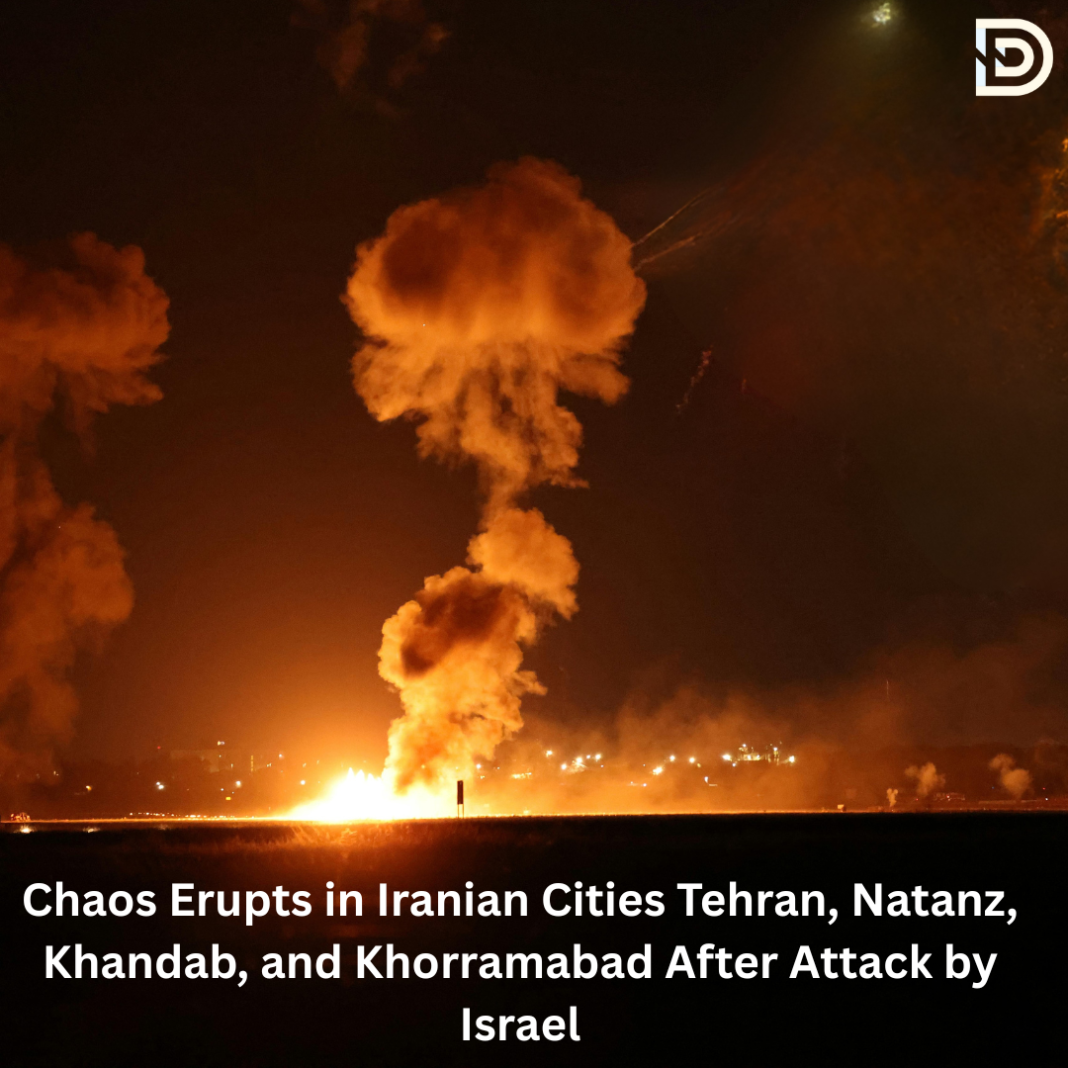


In the dark stillness of early Friday morning, Iran woke to the sound of sirens, explosions, and chaos. Israel launched a massive wave of precision airstrikes targeting Iran’s most critical nuclear facilities and military command centers in what experts are calling the largest and most coordinated Israeli military strike in history.
The operation—which struck Tehran, Natanz, Khandab, and Khorramabad—is a direct response to Iran’s accelerating nuclear program, long viewed by Israeli and Western security officials as a grave and imminent threat.
The sheer scale and precision of the operation, combined with its deliberate focus on nuclear infrastructure, signals a dramatic escalation in the shadow conflict between Israel and Iran—and raises the question: Was this the night that reset the Middle East’s nuclear trajectory?
🧪 Natanz: Iran’s Atomic Heartbeat Crippled
No site better represents Iran’s nuclear aspirations than Natanz, a sprawling complex nestled in central Iran. Heavily fortified and largely subterranean, Natanz is where thousands of centrifuges work continuously to enrich uranium—the critical ingredient in both civilian energy programs and, at higher purity, nuclear weapons.
Under the 2015 nuclear deal (JCPOA), Iran was limited to enriching uranium to 3.67% purity using basic IR-1 centrifuges at Natanz. But after the U.S. withdrawal from the deal in 2018, Iran escalated enrichment to 60%—a stone’s throw from weapons-grade (90%).
The Israeli airstrikes at Natanz, confirmed by satellite data and Iranian state media, were not symbolic—they were surgical. Bunker-buster bombs penetrated hardened underground halls, reportedly destroying hundreds of centrifuges and disrupting power systems across the facility.
Two prominent nuclear scientists, Fereydoun Abbasi-Davani and Mohammad Mehdi Tehranchi, were killed during the assault—both critical figures in Iran’s uranium enrichment and nuclear theory programs. Their deaths represent a devastating intellectual loss to Iran’s nuclear command.
🌊 Khandab: The Heavy Water Reactor and Its Dark Legacy
Located near Arak, the Khandab facility—often referred to as the Arak Heavy Water Reactor—has long been a focal point of Western concern. Heavy water reactors, unlike light water versions, produce plutonium as a byproduct—a key component for nuclear weapons.
While Iran pledged to redesign this facility under the JCPOA to prevent weapons-grade plutonium production, satellite imagery and IAEA reports in 2024 suggested ongoing construction inconsistent with those commitments.
Israel’s strike on Khandab was described by military analysts as “deep and destructive.” Explosions reportedly targeted the reactor core’s auxiliary systems and the site’s experimental cooling facility. Experts believe this could set back any secret plutonium pathway by several years.
🚨 DECLASSIFIED: Iran’s Nuclear Plot Exposed — Israel Responds with Preemptive Strikes
🚀 Khorramabad: Iran’s Missile Shadow Factory
While lesser known to the public, Khorramabad plays a vital role in Iran’s nuclear delivery capability. The city houses one of Iran’s primary ballistic missile storage and launch centers, believed to be tied to Shahab and Khorramshahr missile programs.
Intelligence gathered by Western sources in recent years pointed to integration testing of warhead-missile compatibility at the Khorramabad site—a red line for Israeli defense doctrine.
The Israeli airstrikes leveled several hardened silos and what appears to be a missile assembly hangar. A fireball captured on CCTV footage suggests a massive secondary explosion, possibly due to a munitions depot being hit.
Military officials in Jerusalem later confirmed this strike was essential to neutralizing Iran’s first-strike nuclear potential.
🏙️ Tehran: The Brain of Iran’s Military-Nuclear Nexus
Tehran, Iran’s capital, is more than just a political hub—it is the strategic and operational nerve center of Iran’s military and nuclear planning. The Ministry of Defense, the Atomic Energy Organization of Iran (AEOI) headquarters, and the residences of top commanders are all located within Tehran’s urban sprawl.
Multiple explosions rocked the capital just before 3:00 AM local time, striking what Israeli intelligence identified as underground command bunkers and communications nodes. IRINN, Iran’s state broadcaster, confirmed the deaths of General Mohammad Bagheri, Chief of the Armed Forces, and Hossein Salami, Commander of the Islamic Revolutionary Guard Corps (IRGC).
These two figures were not just military leaders—they were architects of Iran’s “Axis of Resistance” strategy and guardians of Iran’s clandestine nuclear assets.
The strike on Tehran sends a chilling message: Even the most guarded locations are no longer safe from Israeli precision.
🌍 A Regional Earthquake with Global Aftershocks
The global implications of these strikes are enormous. Within hours of the attack:
-
Israel declared a national state of emergency, closing its airspace.
-
Iran placed its missile and drone units on full alert.
-
Oil prices surged 9% overnight.
-
The IAEA confirmed a meeting of the UN Security Council was imminent.
-
Western airlines rerouted or suspended flights through the region.
U.S. President Joe Biden condemned Iran’s nuclear violations but warned Israel against escalating further. In contrast, Israeli Prime Minister Benjamin Netanyahu remained defiant, declaring:
“This operation will continue for as long as needed. Iran’s nuclear ambitions end here, not in Vienna, not in Geneva—but in Natanz and Khandab.”
📌 Why These Sites Matter
| Location | Strategic Significance |
|---|---|
| Natanz | Main uranium enrichment center with deep bunkers |
| Khandab | Heavy water reactor capable of producing plutonium |
| Khorramabad | Ballistic missile storage and launch facility |
| Tehran | Military HQs, nuclear command, key leadership hub |