


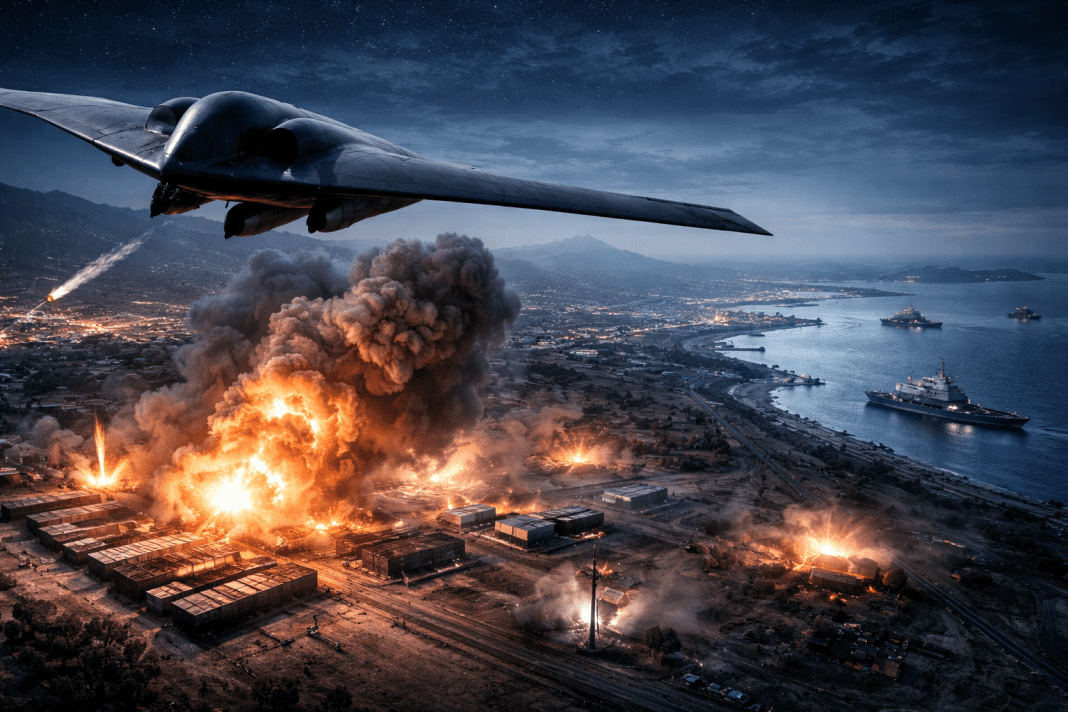


Tensions in the Middle East have risen after reports of a US airstrike on an ammunition depot in Iran’s Isfahan region. According to US officials, the attack involved bunker-buster bombs targeting a fortified military site. The incident comes amid ongoing conflict, diplomatic talks, and growing concern over key energy routes like the Strait of Hormuz, drawing global attention to the escalating situation.
US Strike on Isfahan Ammunition Depot Sparks Global Attention
The United States military has reportedly carried out a major airstrike on a large ammunition depot in Iran’s Isfahan region, according to US officials cited by The Wall Street Journal. The strike comes amid rising tensions in the region, which have now entered their second month of conflict.
The targeted facility is believed to be a military-linked storage site in central Iran. Isfahan is known for hosting key defence installations, including airbases and weapons storage areas such as the Badr airbase. Officials said the strike involved 2,000-pound bunker-buster bombs, equal to about 907 kilograms each, designed to destroy deep underground targets.
B-1B Lancer bombers strike deep inside Iran in long-range missile operation
Footage shared by US President Donald Trump on Truth Social showed large nighttime explosions and fires, though it has not been independently verified. The report has drawn global attention due to the scale of the strike and the ongoing escalation in regional tensions.
907 kg Bunker-Buster Bombs and the Role of the B-2 Spirit Aircraft
The weapons reportedly used in the strike are bunker-buster bombs, which are not ordinary explosives. Engineers specially design them to penetrate deep underground or through reinforced concrete before they detonate, allowing them to destroy heavily protected military structures and hidden underground facilities.
Each bomb weighs around 2,000 pounds, or approximately 907 kilograms. Their heavy design and strong penetration ability make them effective against fortified targets that are difficult to reach with standard weapons.
Reports also suggest the mission may have involved the B-2 Spirit stealth bomber, one of the most advanced military aircraft in service. Developed by Northrop Grumman during the Cold War, the B-2 features a flying-wing design that reduces radar detection and makes it extremely hard to track.
B-21 and F-47 fleets too small to strike deep inside China in Taiwan war, report warns
Manufacturers built only 21 B-2 aircraft, and each costs around 2.1 billion dollars, making it one of the most expensive military planes ever produced. A two-person crew operates it, while advanced computer systems support most of its functions and reduce pilot workload.
The B-2 has a long operational range of about 7,000 miles (11,000 kilometres) without refuelling, which can extend to 11,500 miles (18,500 kilometres) with aerial refuelling. This capability allows it to reach targets across the globe quickly. It carries multiple types of precision-guided weapons, including bunker-busters, and performs missions in heavily defended airspace.
Regional Diplomatic Talks Continue Amid Strait of Hormuz Tensions
The strike comes amid ongoing diplomatic efforts involving several regional powers, including Pakistan, Egypt, Saudi Arabia, and Turkey. These countries are holding talks aimed at reducing tensions and preventing further escalation of the conflict in the region.
The discussions focus on maintaining stability in a highly sensitive area that plays a major role in global energy supply. A key concern is the Strait of Hormuz, a narrow but strategically vital waterway through which a large share of the world’s oil trade passes. Any disruption in this route could significantly impact global energy markets and supply chains.
US President Donald Trump has reportedly warned Iran that if talks with what he called a “new, and more reasonable regime” fail, and if Iran does not reopen the Strait of Hormuz, the US may take further action against Iranian energy infrastructure. According to officials cited by The Wall Street Journal, he has also suggested that the US may end the current military campaign even if the strait remains partially closed, while it may handle efforts to reopen it separately later.
Officials have mentioned energy facilities such as oil wells, power plants, and Kharg Island as possible points of concern, highlighting the strategic importance of Iran’s energy infrastructure in the ongoing tensions.