


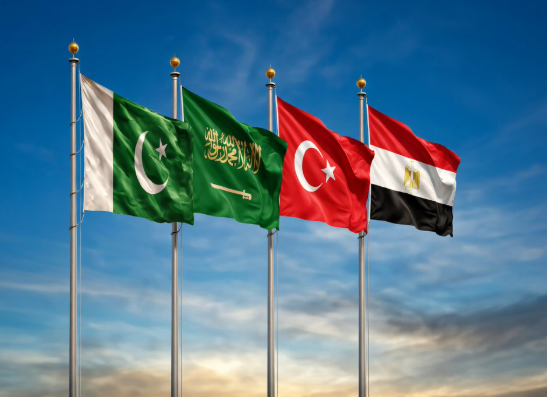


The idea of an “Islamic NATO” is being discussed again as Pakistan prepares to host key talks amid rising tensions in the Middle East, especially due to the ongoing conflict involving Iran, the United States, and Israel. The meeting will include Turkey, Saudi Arabia, and Egypt, marking the first such gathering since the conflict escalated.
Pakistan is also positioning itself as a mediator, engaging in quiet diplomacy and reportedly passing messages between key countries. This has brought attention to its growing role as a bridge in regional discussions.
A New Grouping Takes Shape
The planned meeting in Pakistan is being described as a quadrilateral dialogue involving four key countries from the Muslim world, often being linked to the idea of an Islamic NATO. Together, they hold strong political, military, and economic influence across South Asia, the Middle East, and North Africa.
Pakistan signals negotiated safe passage as state-run tanker clears the Hormuz blockade
Earlier, growing cooperation between Pakistan, Saudi Arabia, and Turkey had already sparked comparisons to a NATO-like structure, often referred to as an emerging Islamic NATO. With Egypt now joining, these comparisons have resurfaced. Reports also suggest that a previous understanding included a clause similar to NATO’s Article 5, where an attack on one member is treated as a threat to all.
However, officials have clarified that the focus is not on forming a military alliance, but on promoting peace and stability. The meeting was also moved to Pakistan due to logistical reasons, further highlighting the country’s central role in ongoing regional developments.
Rising Tensions Drive Urgency
The backdrop to this meeting is the ongoing conflict involving Iran, which has now entered a more intense phase. The situation has raised concerns globally, especially due to the risk of wider escalation in the Middle East.
The region is already one of the most sensitive areas in the world. It is home to key oil routes, major economies, and long-standing political rivalries. Any increase in conflict here has global effects, including on energy prices and international security.
Pakistan weighs defence commitments as Saudi Iran tensions rise amid test of pact and global balance
Amid these tensions, countries are looking for ways to prevent further escalation. This is where the proposed grouping is positioning itself—as a platform for dialogue rather than confrontation.
Pakistan’s involvement in backchannel diplomacy has added another layer to its role. Reports suggest that it has been actively involved in passing proposals aimed at reducing tensions. This has increased its visibility as a mediator in the conflict.
At the same time, Pakistan itself is dealing with internal challenges and regional tensions. Its outreach efforts appear to be part of a broader strategy to strengthen its diplomatic standing.
Islamic NATO: Peace Platform or Strategic Alliance?
The idea of an “Islamic NATO” continues to spark debate, as discussions around this emerging grouping gain attention. While some observers see clear similarities with a military alliance, others argue that its purpose is quite different. Unlike NATO, this grouping does not have a formal structure, an official charter, or a unified military command, making it less rigid and more informal in nature.
Instead, what appears to be forming is a flexible alignment built around shared interests. These include maintaining regional stability, strengthening economic cooperation, and addressing common security challenges. The approach so far suggests coordination and dialogue rather than the creation of a strict defence alliance.
Pakistan signals end of neutrality, invoking defense alliance to stand by Saudi Arabia
The inclusion of Egypt adds further weight to this development. It broadens the grouping’s reach into North Africa and enhances its overall regional influence. At the same time, Turkey’s involvement adds another layer of complexity, as it remains part of NATO while also engaging in this parallel framework, linking the dialogue to wider global dynamics.
The discussions are expected to focus on the ongoing conflict, regional security concerns, and possible diplomatic solutions. For now, the grouping is being positioned as a platform for dialogue and cooperation. Although its final shape remains uncertain, the increasing coordination among these countries is becoming more noticeable in the current geopolitical landscape.