


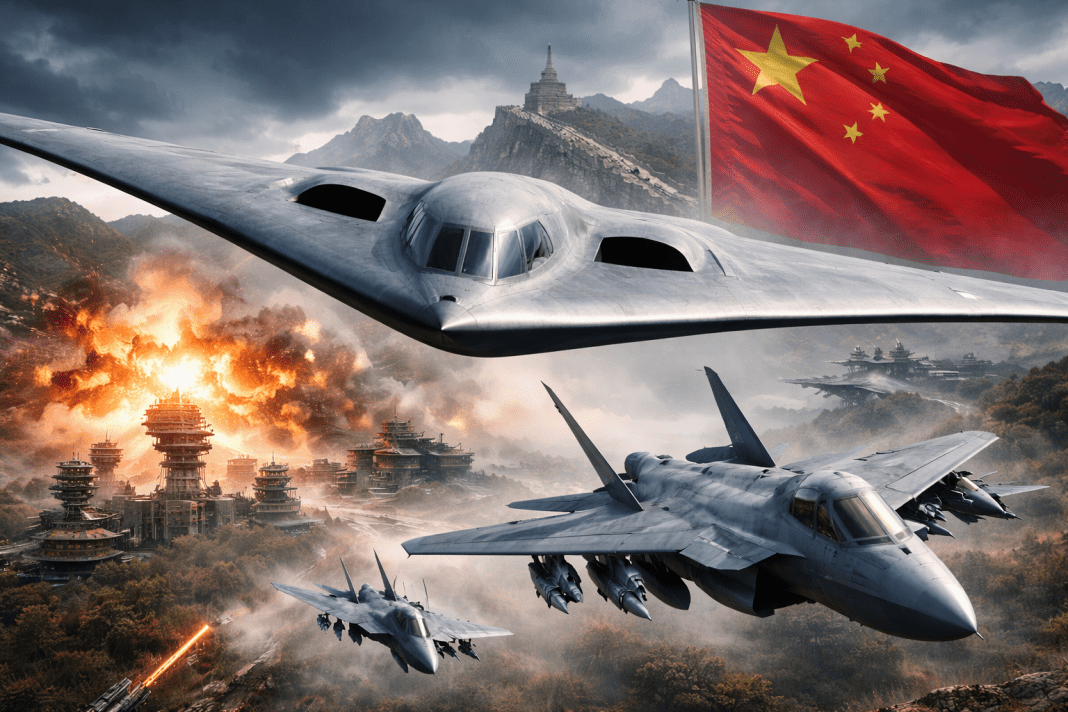


The U.S. Air Force may not have enough next-generation bombers and fighters to fight a sustained war with China, particularly in a conflict centered on Taiwan, according to a report released on 4 February 2026 by the Mitchell Institute for Aerospace Studies.
The report argues that current plans for the B-21 Raider stealth bomber and the future F-47 fighter are designed to replace older aircraft rather than meet the demands of a prolonged, high-intensity conflict against a major power. The study was written by defense analyst Heather Penney and retired U.S. Air Force Colonel Mark A. Gunzinger and was reported by Air Force Magazine.
According to the authors, the Air Force risks being unable to maintain continuous pressure inside heavily defended Chinese airspace if a war were to break out in the Indo-Pacific region. They say current force planning places too much emphasis on cost control and not enough on operational credibility.
The report focuses on the challenge of denying China what it describes as “protected rear areas” — regions where Chinese military forces could operate with relative safety due to long-range air defenses, geography, and depth.
Current aircraft plans questioned
The Air Force currently plans to acquire at least 100 B-21 Raider bombers and about 185 F-47 fighters. These numbers are largely intended to replace aging aircraft such as the B-1B Lancer bomber and the F-22 Raptor fighter as they retire from service.
Penney and Gunzinger argue that replacement-level procurement is not sufficient for a conflict with China, which they describe as a peer competitor with the ability to disperse forces across a large and well-defended territory.
The B-21 Raider, developed under the Long Range Strike Bomber program, is designed to penetrate advanced air defense systems rather than rely mainly on stand-off weapons. It builds on the flying-wing design of the B-2 Spirit while incorporating newer stealth features, updated avionics, and improved survivability.
The aircraft is intended to carry both conventional and nuclear weapons and to conduct repeated deep-strike missions against high-value targets. The report notes that the B-21’s long range and endurance are central to its role in future conflicts across the Indo-Pacific.
The F-47 fighter, part of the Next Generation Air Dominance program, is expected to replace the F-22 as the Air Force’s primary air superiority platform. While many details remain classified, the Air Force has confirmed that the aircraft will emphasize long range, high speed, and the ability to operate deep inside contested airspace.
The F-47 is expected to work alongside uncrewed aircraft and advanced sensor networks, providing escort for bombers, suppressing enemy air defenses, and helping maintain air superiority during sustained operations.
Larger fleets seen as necessary
The report concludes that a force capable of sustained operations against China would require at least 200 B-21 bombers and around 300 F-47 fighters. The authors say these higher numbers reflect real-world operational demands, including aircraft losses, maintenance downtime, and training requirements.
Taiwan detains journalist in rare espionage case over alleged military leaks to China
They also point out that not all aircraft in the inventory would be available for a Taiwan-related conflict. Some bombers would remain assigned to nuclear deterrence missions, while fighters are routinely used for homeland defense and other standing tasks.
As a result, the number of aircraft actually available for prolonged operations in the Indo-Pacific would be much smaller than headline procurement figures suggest.
Until larger fleets can be built, a process the authors say could take more than a decade, the report recommends slowing the retirement of the remaining B-2 Spirit bombers and increasing purchases of the F-35 Lightning II.
The F-35, the report says, already offers advanced sensors and limited penetration capability, even though it lacks the range and payload of a heavy bomber.
Concerns over reliance on stand-off weapons
The report also raises concerns about growing reliance on stand-off weapons, including long-range hypersonic missiles. While such systems reduce risk to aircraft, the authors argue they are costly and depend on complex sensor and communications networks that could be disrupted during a major war.
They note that some hypersonic weapons cost tens of millions of dollars per missile, meaning large sums could be spent quickly while delivering fewer effects than repeated bomber missions.
According to the study, penetrating aircraft operating inside defended airspace can strike air bases, command centers, logistics hubs, and missile launch sites directly. The authors say this approach reduces an adversary’s ability to regenerate forces and sustain operations over time.
The report draws on historical examples where conflicts were prolonged because adversaries retained protected sanctuaries, compared with wars where sustained deep strikes limited an opponent’s ability to adapt.
China warns Europe not to admit Taiwanese politicians, citing diplomatic ‘red lines’
The study concludes that expanding penetrating strike forces would demonstrate that the United States intends to hold key targets at risk throughout a conflict, a posture the authors say would shape deterrence and military planning in the Indo-Pacific