


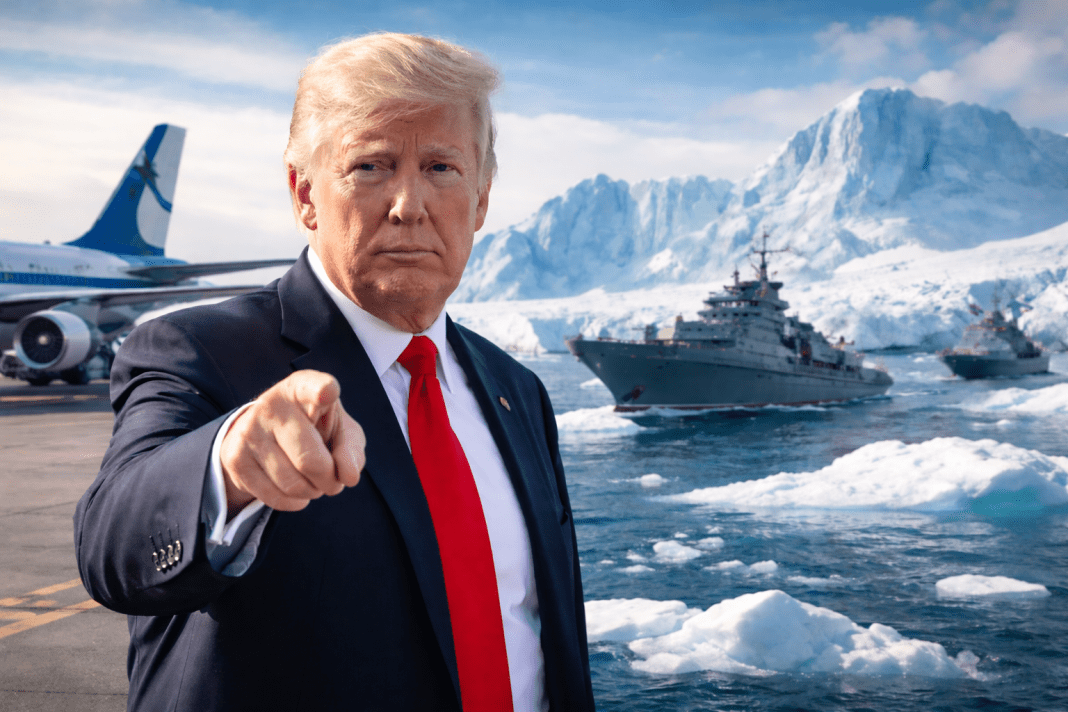


US President Donald Trump stirred fresh debate after making a cryptic remark about Greenland aboard Air Force One, shortly after the US confirmed a major military operation in Venezuela. Saying the US “needs Greenland” for national security and claiming Russian and Chinese ships are active around the island, Trump avoided details and told reporters to “ask me in 20 days,” adding to questions about America’s intentions in the Arctic and the wider Western Hemisphere.
Trump’s Comments Aboard Air Force One Raise Questions
On Monday, while flying back to Washington from Florida, President Donald Trump was asked by reporters about Greenland, following his earlier remarks suggesting the US might consider taking control of the island. Instead of giving a clear answer, Trump told reporters to “ask me in 20 days,” avoiding confirmation or denial of any policy move.
Despite the vague response, Trump emphasized that the United States “needs Greenland from a national security standpoint.” He called the island “very strategic right now” and claimed it was “covered with Russian and Chinese ships.” His comments signaled that he sees Greenland as a key area in rising global competition.
New year, new red line: Denmark’s PM delivers stark warning on Greenland
Greenland, an autonomous territory within the Kingdom of Denmark, occupies a strategic location between North America and Europe. Its position has made it important for military surveillance, early-warning systems, and defense planning. By stating that Denmark “is not going to be able to do it,” Trump implied that Copenhagen cannot fully protect the island from foreign influence.
While Trump offered no concrete evidence for his claims about Russian and Chinese presence, his remarks reignited international debate over the Arctic’s strategic importance. The statement reflects his broader focus on asserting American influence and protecting US interests in regions considered vital for national security.
Greenland and US National Security Focus
Discussions about the United States taking control of Greenland are not new. Trump has spoken about the island before, but his recent remarks come at a time of heightened global tension and renewed US military action abroad.
According to Trump, Greenland’s importance is directly tied to national security. He emphasized this point multiple times while speaking to reporters, repeating that the island’s strategic value has increased due to foreign naval activity in surrounding waters.
Greenland hosts critical air and radar facilities, including the US-operated Pituffik Space Base, formerly known as Thule Air Base. These installations are important for missile warning systems and space surveillance. For decades, the US has considered the Arctic a key region for early defense detection.
U.S. weighs direct role in Greenland rare earths development through $50 million plan
Trump’s comments suggest that his administration sees growing competition in the Arctic from both Russia and China. Russia has expanded its Arctic military presence in recent years, while China has declared itself a “near-Arctic state” and invested in polar research and shipping routes.
Although Trump did not outline any specific action plan, his repeated use of the phrase “we need Greenland” has drawn attention because it frames the issue as a necessity rather than a diplomatic option. This framing has raised concerns among US allies and partners, particularly Denmark, which has consistently stated that Greenland is not for sale.
Trump’s remarks also align with his broader approach to foreign policy, where he often emphasizes strength, leverage, and national interest over traditional diplomatic language.
Venezuela Operation and Expanding US Role in Western Hemisphere
Trump’s Greenland remarks came shortly after the US ousted Venezuelan leader Nicolás Maduro in a bold military operation, marking a major shift in the region’s political balance. The timing of his comments has drawn attention, linking Greenland’s strategic value to broader US actions in the Western Hemisphere.
Asked if Venezuela’s military action could hint at similar moves elsewhere, including Greenland, Trump gave a vague response, saying others would have to judge and that he “really didn’t know.” His answer avoided any direct confirmation of US plans.
Reports of Nicolás Maduro capture prompt Venezuelan army to mobilise entire population against US
The administration’s National Security Strategy emphasizes restoring “American preeminence in the Western Hemisphere,” and Trump has repeatedly cited the Monroe Doctrine and Roosevelt Corollary to justify US influence in neighboring regions. These references highlight his broader approach to national security.
By calling Greenland strategically vital and telling reporters to “ask me in 20 days,” Trump stressed its importance for US security while offering few details. His cryptic remarks leave both allies and rivals watching closely, interpreting what America’s next moves might be.