


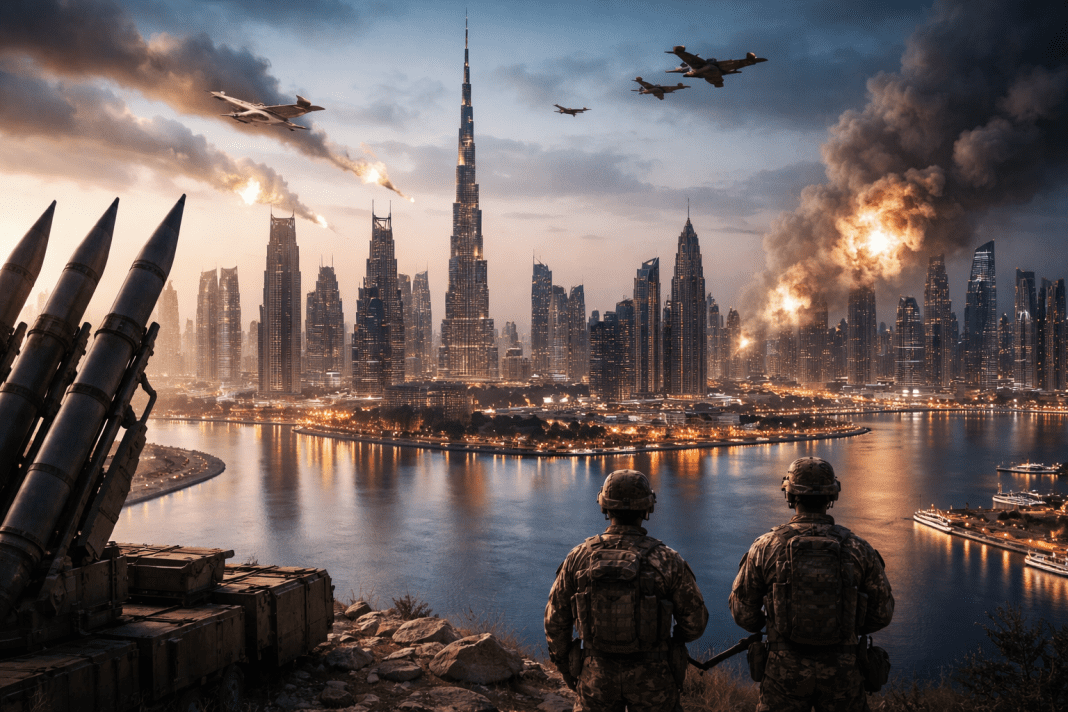


Rising tensions in the Middle East have raised fresh concerns about the UAE’s security and foreign policy choices. A leading American economist has warned that deeper involvement in regional conflicts could expose cities like Dubai and Abu Dhabi to serious risks. His remarks highlight fears linked to growing geopolitical alliances and the potential impact of escalation involving Iran and other regional powers.
Shock Warning Over UAE’s Exposure in a Possible Regional War
A leading American economist has warned the United Arab Emirates about rising Middle East tensions involving Iran and its regional rivals. He said the UAE could be drawn into a wider conflict. In such a scenario, cities like Dubai and Abu Dhabi could face serious danger. These places were described as global hubs for tourism, trade, and luxury living.
According to him, these cities are not built to withstand large-scale missile attacks or military conflict. Their infrastructure focuses on attracting international visitors and investment. This includes skyscrapers, financial districts, and luxury developments. He said they lack strong wartime defenses.
He also noted that Dubai and Abu Dhabi hold vast financial assets and host people from many countries, making them highly exposed in a conflict scenario. He warned that modern warfare can quickly impact densely populated cities that are not built as fortified zones. His remarks stressed that involvement in a regional war could threaten both the safety and global reputation of these urban centers.
Concerns Over Strategic Alliances and Regional Security Risks
The economist raised concerns about the UAE’s long-term foreign policy direction. He focused on its close partnerships with powerful global allies in the Middle East. He highlighted diplomatic agreements involving the United States and Israel as part of a broader regional alignment.
These partnerships depend on strong external protection in exchange for political cooperation. However, he warned that this approach carries hidden risks in a region with fast-escalating tensions involving multiple actors.
He called this strategy a “miscalculation.” He said heavy reliance on external military protection may create a false sense of security. It may also encourage more assertive policy decisions. At the same time, it can reduce caution about being pulled into larger conflicts.
UAE arrests 19, including Indians, in major deepfake-driven disinformation crackdown
He also referenced a well-known geopolitical idea linked to a former US diplomat. It suggests that both opposition to and close alignment with a global superpower can carry long-term risks.
According to his warning, countries may become indirectly involved in wider regional confrontations. These include proxy wars, missile exchanges, and retaliatory actions across the Middle East.
Abraham Accords Described as a Turning Point in Regional Alignment
The interview also focused on diplomatic agreements known as the Abraham Accords, which normalized relations between Israel and several Arab nations, including the UAE. The economist described these agreements as a major turning point in UAE Middle Eastern politics, changing long-standing regional alignments.
He claimed that such agreements increased the UAE region’s dependence on external military and political support. This support is mainly linked to the United States. In his view, this deeper involvement has created new layers of strategic risk. He said these risks are rising as tensions in the broader region continue to grow.
He warned that closer alignment with powerful allies in a volatile region can sometimes increase UAE exposure instead of reducing it. According to him, Gulf nations now face a complex position. Economic ambition and security concerns are closely tied to international politics.
How the UAE’s global role makes it central to Iran’s indirect pressure strategy
He also repeated a well-known geopolitical phrase linked to a former US foreign policy leader. It states that close friendships between nations can become risky when global tensions rise. He used this idea to highlight that international alliances may be beneficial in peaceful times. However, they can also bring serious consequences during conflict.
The remarks highlighted fears of rapidly changing geopolitical dynamics. These changes could directly affect highly developed urban centers like Dubai and Abu Dhabi. These cities are major hubs for global business, tourism, and investment.