
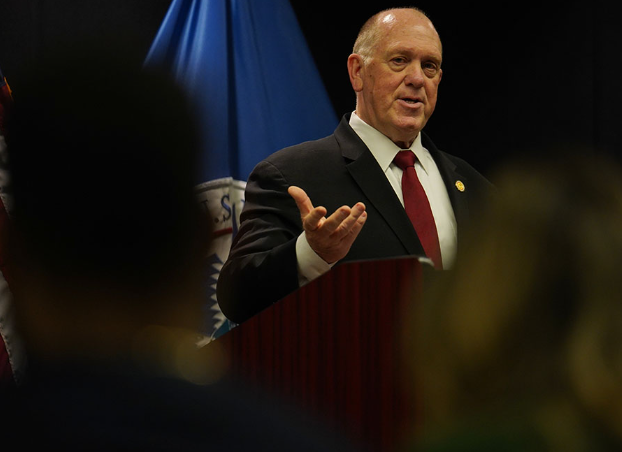

The Trump administration will immediately pull about 700 immigration officers out of Minnesota. Border czar Tom Homan announced the move. The broader immigration enforcement operation will continue. The decision comes amid ongoing tensions linked to President Donald Trump’s push for large-scale deportations.
Federal immigration officers to leave after cooperation deal
Tom Homan said about 700 immigration officers are being withdrawn. The decision followed an agreement by Minnesota state and local officials to cooperate with federal authorities. This cooperation includes turning over immigrants arrested by local law enforcement.
The officers being pulled out make up roughly one-quarter of the federal force deployed in the state. Homan said the reduction will start immediately. About 2,000 immigration officers will remain in Minnesota.
The enforcement surge began in early January. The Department of Homeland Security called it its largest immigration operation ever. Homan said increased cooperation allows federal agencies, including ICE, to continue enforcement with fewer officers.
Enforcement operation continues amid tensions and violence
While the withdrawal of 700 officers marks a significant change, Homan stressed that the broader enforcement operation will continue. He did not give a timeline for when the operation might end, leaving uncertainty about how long federal officers will remain active across Minnesota.
The enforcement surge has sparked weeks of tension throughout the state. Community groups, immigrant advocates, and some local leaders have criticized the operation, saying it has created fear among immigrant families and disrupted daily life in many neighborhoods.
The situation escalated further after two deadly shootings in Minneapolis. U.S. citizens Renee Good and Alex Pretti were killed during incidents that occurred amid the heightened tensions surrounding immigration enforcement. These deaths intensified public debate and brought national attention to what was happening in Minnesota.
ICE agent Jonathan Ross faces doxxing attempt by woman after shooting incident in Minnesota
Although Homan mentioned the shootings as part of the context surrounding the operation, he did not link the reduction in officers directly to those events. Instead, he focused on the agreement reached with state and local officials as the main reason for the drawdown.
Federal officials have repeatedly said that their goal is to enforce immigration laws as written and to remove people who are in the country illegally, especially those with criminal records. Critics, however, argue that the operation has gone beyond that focus and has affected broader communities.
Minnesota becomes flashpoint in national immigration debate
Minnesota has taken on a larger role in the national immigration debate since a major enforcement surge began in January. The state has become a key testing ground for the Trump administration’s immigration strategy and its efforts to increase cooperation with local governments.
When the operation first expanded, thousands of federal immigration officers were sent to Minnesota. The scale of the deployment was unusual and quickly drew attention from national media, advocacy groups, and political leaders. Border czar Tom Homan described the effort as a central part of President Donald Trump’s mass deportation push, saying the administration views Minnesota as an important focus because of its undocumented immigrant population.
Justice Department probes Minnesota Democrats as clash over ICE enforcement turns federal
A recent agreement by state and local officials to turn over arrested immigrants marks a shift in how Minnesota works with federal immigration agencies. Cooperation between local law enforcement and federal officers has long been controversial. Supporters say it strengthens public safety and helps enforce immigration laws more consistently. Critics argue it can weaken trust between immigrant communities and local police, making people less likely to report crimes or seek help.
Even with 700 officers being withdrawn, about 2,000 federal agents will remain in Minnesota. As a result, immigration enforcement is expected to stay a major and closely watched issue in the state.