


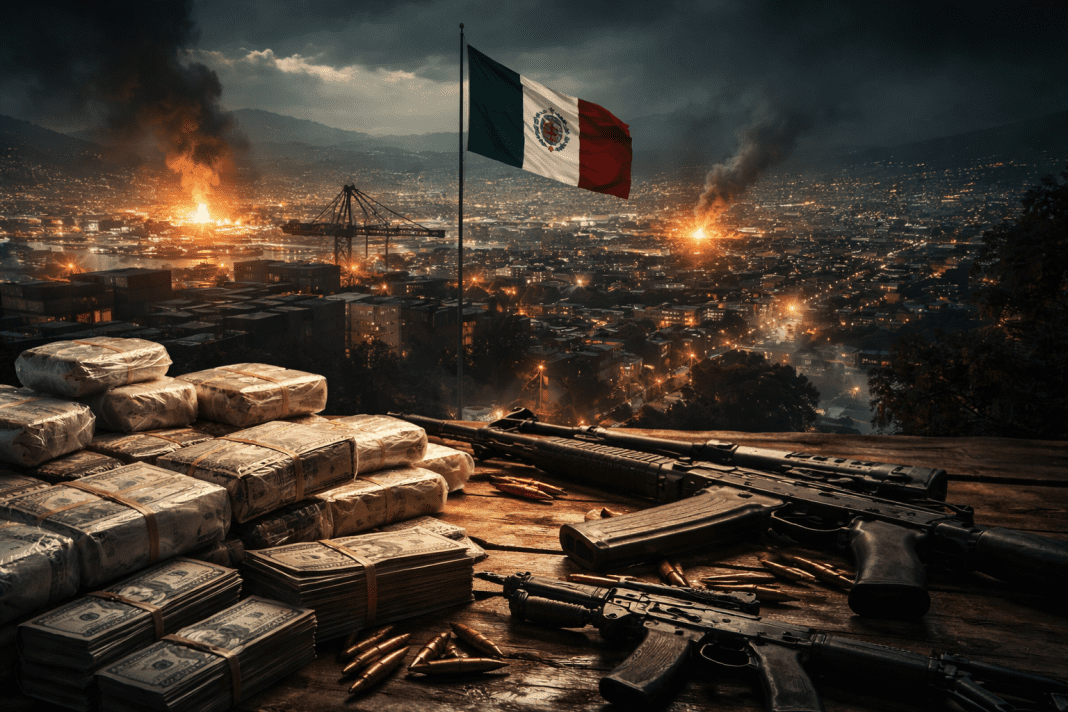


Mexican drug cartels are not just criminals—they are reshaping how governments operate. Recent US actions designating major Mexican cartels as Foreign Terrorist Organizations (FTOs) highlight a new way of looking at organized crime. This is not about punishing criminals randomly. It shows that some criminal networks act like political forces. They influence how governments make decisions, limit the authority of security forces, and control regions in ways that matter for both national and global strategy.
Cartels and the Rise of Organized Crime as Political Power
When we think of cartels, we often imagine illegal business and violence. In Mexico, however, cartels do more than that. They control cities, border crossings, ports, and other key areas. They influence how people move, which markets operate, and even which laws are enforced. While not seeking to take over the government, organized crime in these regions effectively shapes local governance, often alongside weak or compromised institutions.
In some areas, cartels act like local governments. They provide stability and enforce rules out of operational necessity, a system called “criminal governance.” Organized crime dictates how communities function, limiting the government’s ability to make decisions. Cartels create their own rules, and state institutions must work within these boundaries.
U.S. declares open war on Mexican cartels: Death toll soars to 157 in Pacific strikes
Violence and corruption reinforce this system. Cartels manipulate officials and compromise security forces, creating intelligence and enforcement blind spots. Over time, these weaknesses can be exploited by other powerful actors without direct interference.
The US-Mexico Cooperation Challenge
For many years, the United States and Mexico maintained a close partnership to combat powerful drug cartels. They carried out joint operations, shared intelligence, and coordinated law enforcement efforts. These initiatives helped weaken some cartel leadership and disrupt criminal networks, showing that cooperation could produce tangible results in fighting organized crime.
However, over time, trust between the two governments has weakened. Policy changes, shifting priorities, and high-profile corruption cases in Mexico strained collaboration. These developments made it harder for US officials to access critical information or operate alongside Mexican authorities, leaving important gaps in oversight and enforcement.
As a result, cartels have been able to recover quickly. When the US applies pressure, it often produces short-term compliance or tactical victories, but these are fleeting. Criminal groups adapt and reorganize, exploiting weaknesses in governance and security to maintain control over key areas, such as border crossings, ports, and trafficking corridors. Organized crime thrives in these conditions, taking advantage of fragmented enforcement and inconsistent strategies.
Without a clear, shared strategy, these temporary actions cannot achieve long-lasting results. Effective cooperation requires more than tactical targeting; it needs a combination of law enforcement, political solutions, and governance restoration. Until both governments align on a strategic plan, joint efforts remain fragile, and organized crime continues to hold significant influence over strategic regions.
Cartels in Global Strategic Competition
Mexican cartels also play a role in global strategic dynamics. While they operate for profit, their networks create opportunities for other countries to exploit vulnerabilities. For example, cartels control ports, financial systems, and transportation routes. These areas could be used indirectly by foreign actors to gain strategic advantages.
International networks, such as suppliers from other countries, can provide chemicals or resources used in drug production. Cartels then distribute these products, generating social and economic crises that affect not just Mexico but also the United States. Organized crime networks work without direct coordination with foreign powers. It is the structure itself, not intentional alliances, that creates strategic risks.
Pentagon-backed operation puts US troops face-to-face with cartels in Ecuador
Cartels also influence local economies. They fill gaps in regions where jobs, loans, and markets are scarce. Communities sometimes rely on the services provided by cartels, even though they are illegal. This makes restoring government control more complicated, as eliminating cartels without offering alternatives could leave communities vulnerable.
The impact is clear: Mexican cartels are not only a law enforcement issue. They are organized crime actors that shape state behavior, influence governance, and indirectly affect global competition. Their presence in strategic regions, combined with the weaknesses of state institutions, creates conditions that other powerful actors could exploit without overt action.