


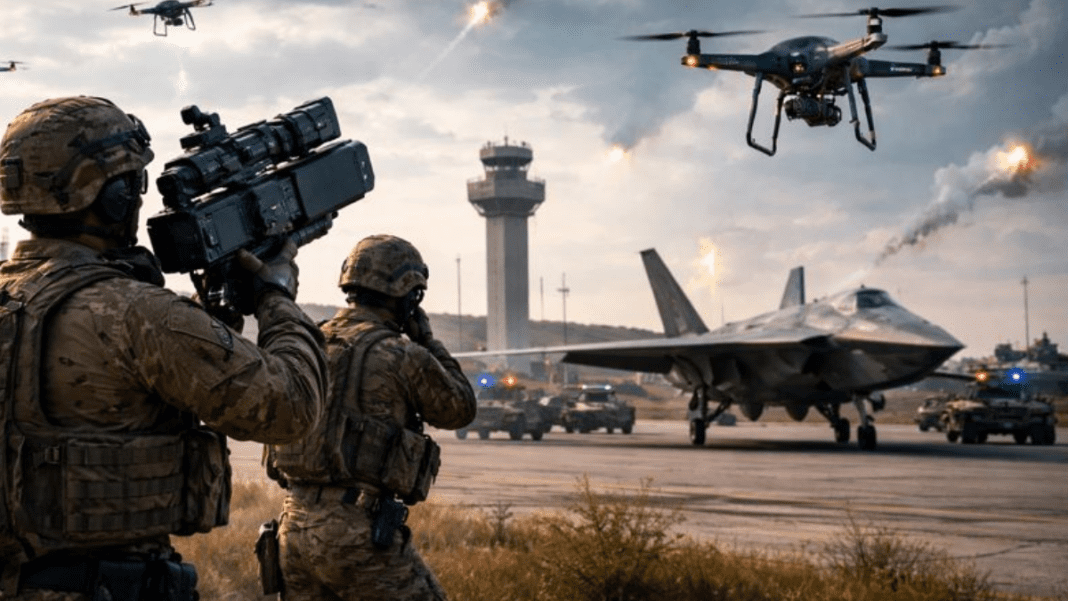


Ukraine’s “Cobweb” operation, which reportedly used small drones to damage high-value Russian military aircraft, has sent a strong warning signal to defense planners around the world. The operation showed that small, low-cost tools can threaten even powerful military systems when defenses move slowly, lack clarity, or suffer from poor coordination.
In response, a Pentagon oversight report revealed that many U.S. military bases and defense facilities remain vulnerable to similar drone threats. The weakness does not come from outdated equipment or lack of funding. Instead, it comes from confusion in laws, unclear authority, and slow coordination. In several cases, military personnel do not know whether the law allows them to stop drones, even when the drones fly directly over sensitive assets.
Drones Are Cheap but Extremely Dangerous
Modern drones are small, fast, and easy to buy. Manufacturers sell many drones for hobby or photography use, but operators can quickly modify them for surveillance or attack. Unlike missiles or aircraft, drones can fly low, quietly, and with little warning, making them hard to detect and stop.
The “Cobweb” operation showed how drones can bypass advanced defenses and strike valuable military targets. In the United States, many bases store aircraft, vehicles, and sensitive equipment outdoors. These areas were designed for efficiency and access, not for protection against small flying devices. This makes them especially vulnerable to drone intrusions.
Poland’s Radosław Sikorski says Starlink is being used by Russia in Ukraine drone strikes
Even when drones are detected, response time is often slow. The delay is not caused by a lack of technology. Many bases have radar, cameras, and security systems. The real problem is uncertainty about who has the legal authority to act. When personnel hesitate, even for a few seconds, drones can reach their targets and cause serious damage.
Small drones do not need to destroy a target completely to be effective. Damaging a sensor, disabling an aircraft, or disrupting operations can have major consequences. This means that even low-cost attacks can result in high losses, especially when defenses are slow or uncoordinated.
Legal Confusion Is Weakening National Defense
One of the most serious findings in the Pentagon report is that current U.S. law does not clearly cover all military facilities when it comes to drone defense. Some training bases, testing centers, and industrial plants fall into unclear legal categories. As a result, personnel at these locations may not have clear permission to shoot down, jam, or otherwise stop drones.
At major pilot training bases, drones have appeared in restricted airspace. However, base staff may not have clear legal authority to take action. This creates a dangerous situation where a threat is visible, but responding to it could carry legal risk.
Single U.S. Patriot system shoots down more than 140 Russian ballistic missiles in Ukraine
A similar problem has occurred at major manufacturing plants that produce sensitive aviation components. Even after repeated drone sightings, officials debated whether these sites qualified for special protection under existing laws. These disagreements delayed responses and left critical facilities exposed.
This legal uncertainty has been described as a “bureaucratic hell.” Commanders must choose between acting to protect national security and risking legal consequences, or waiting for approval and risking damage to vital assets. In fast-moving drone incidents, even short delays can have serious outcomes.
Only 67 Seconds to Detect, Decide, and Defend
Each of these groups operates under different rules, systems, and chains of command. Any delay, confusion, or miscommunication can make even advanced air defense tools useless. A swarm of small, cheap drones could overwhelm defenses simply by exploiting slow decision-making and unclear authority.
Russia bans Renault in retaliation for alleged role in Ukraine’s drone production
This challenge affects more than 500 U.S. military bases across the country. There is currently no single national system that allows commanders at every location to respond immediately and confidently to drone threats. Instead, many decisions require approval across multiple agencies, which is difficult to achieve within seconds.
The Pentagon is now working to improve coordination and clarify legal authority so that responses can be faster, more unified, and legally secure. The report shows that modern threats are evolving faster than laws and procedures, leaving even the most advanced military systems exposed to simple but effective attacks.