
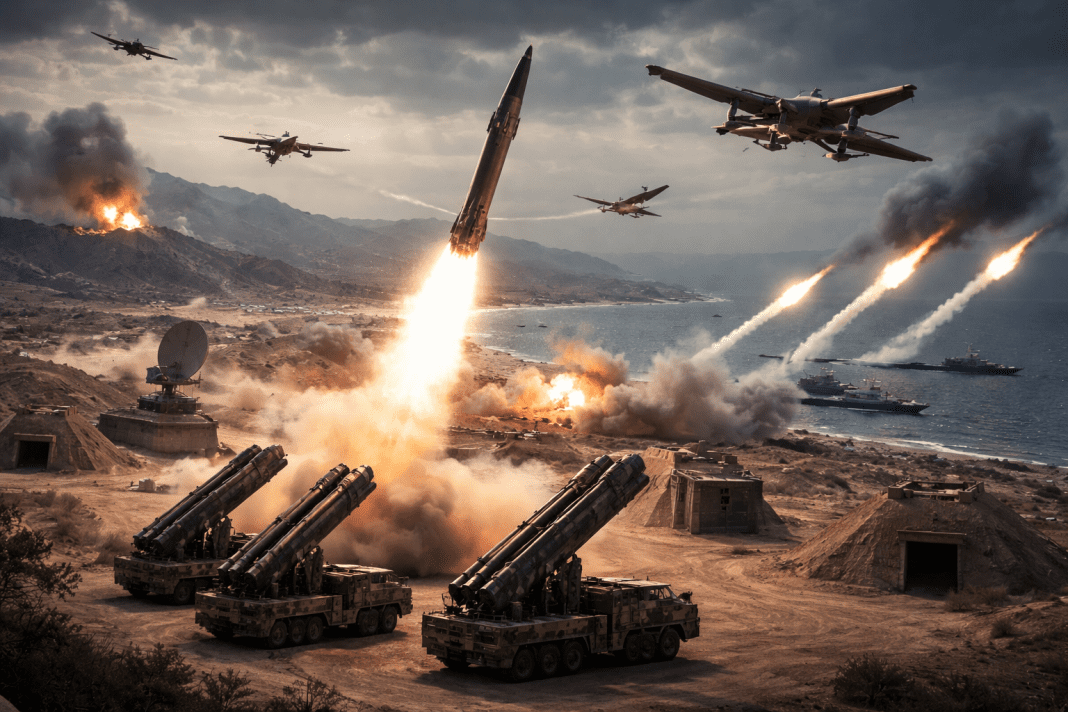

New intelligence is raising doubts about how much of Iran’s military power has actually been weakened in the ongoing conflict. Despite weeks of heavy US and Israeli strikes, reports suggest that a significant portion of Iran’s missile and drone arsenal may still remain intact, adding uncertainty to the situation.
A Different Picture of Iran’s Arsenal Emerges From the Battlefield
A new US intelligence assessment is raising fresh doubts about the damage to Iran’s military in the ongoing conflict. Despite weeks of continuous strikes by American and Israeli forces on key targets, the report suggests much of Iran’s missile arsenal may still be intact.
According to the findings, nearly 50 percent of Iran’s ballistic missile launchers have survived the attacks. This indicates that Iran still has a strong capacity to carry out further strikes if tensions escalate. The report also highlights that thousands of one-way attack drones remain unused, adding to concerns about its remaining arsenal.
Experts warn that a quick end to the Iran war could leave the West at a disadvantage
These findings contrast with earlier claims that Iran has significantly weakened its offensive strength. The assessment also notes that the air campaign has not heavily targeted many coastal defense cruise missiles, suggesting gaps in strategy and leaving parts of Iran’s military arsenal relatively untouched.
Iran Signals Hidden Strength and Undisclosed Capabilities
Amid these reports, strong statements from Iranian military sources suggest that the country may be deliberately holding back a large part of its arsenal. The messaging indicates that what has been seen so far may only be a fraction of its true strength.
Iran has claimed that external assessments of its military power are incomplete and inaccurate. According to these statements, key elements such as missile production sites, advanced drones, and defense systems remain hidden and untouched. The country has also suggested that many of its strategic facilities are located in places that are not known to its adversaries.
Damaged radar systems impact Israel’s defense as Iran missile strikes bypass sensors
The tone of these messages is clear: Iran is signaling that it still has the ability to respond with force if necessary. By emphasizing undisclosed capabilities, it appears to be trying to create uncertainty and caution among its opponents.
The presence of thousands of unused drones is particularly significant. These drones are often used for precision strikes and can overwhelm defense systems due to their numbers. If deployed in large waves, they could pose a serious threat to military bases, ships, and critical infrastructure, further strengthening Iran’s overall arsenal.
The intelligence findings also highlight that Iran’s military strategy may involve conserving resources. Instead of using all its weapons at once, it may be choosing to retain a large arsenal for future use or for a decisive moment.
Contrasting Claims and Ground Realities
The latest intelligence assessment presents a different picture from earlier claims that had almost completely destroyed Iran’s military. While officials previously suggested that Iran had severely weakened its missile systems, navy, and air force, new findings indicate that key parts of its missile program are still operational.
There is clear evidence of heavy damage, with over 12,000 targets reportedly struck and many vessels affected. Attacks involving missiles and drones have also dropped sharply, with reductions of up to 90 percent. However, this decline may not only be due to military pressure. It could also suggest that Iran is deliberately limiting its use of weapons while keeping a large reserve intact.
The 14-day ultimatum: What Donald Trump’s latest speech means for the Iran conflict
The report also highlights that the air campaign has mainly focused on inland and strategic targets. Coastal defense systems, including cruise missiles, have not been targeted as heavily, leaving some capabilities relatively untouched.
Overall, the situation remains uncertain. While there are claims of major military success, intelligence suggests that a significant portion of Iran’s arsenal is still available. This contrast reflects the complexity of modern warfare, where ground realities and public statements do not always fully align.