
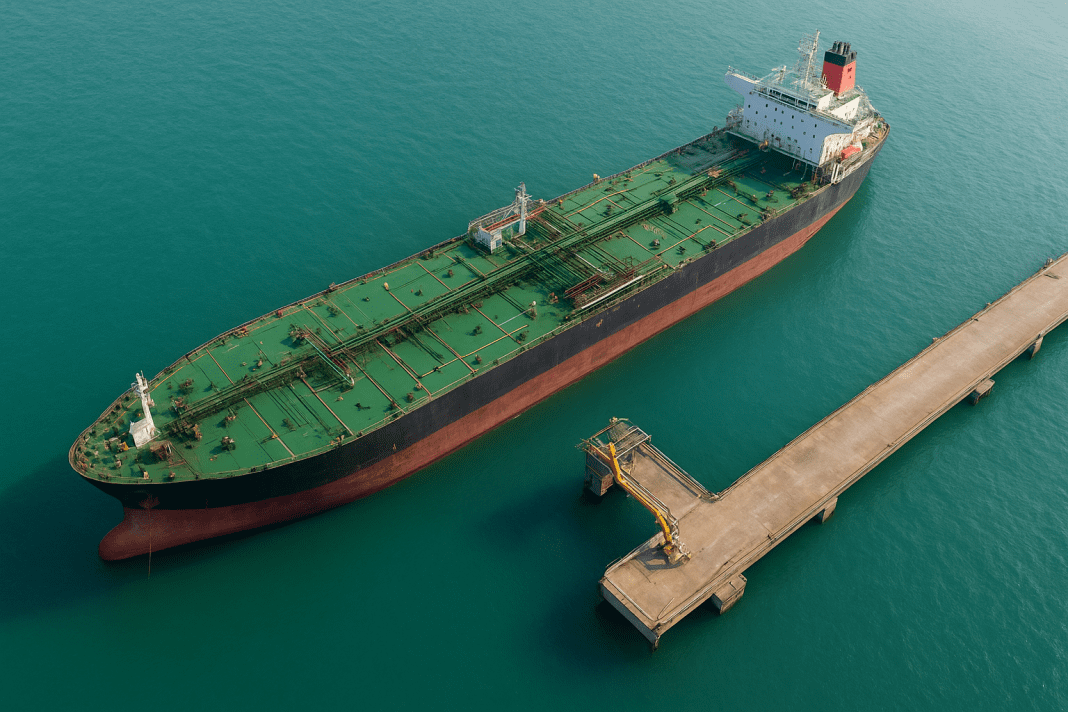

The United States has seized an oil tanker off the coast of Venezuela, setting off major global attention and raising questions about how the vessel managed to keep its location hidden for weeks. The ship, identified by one source as Skipper, is suspected of sending out false tracking signals to disguise its true movements.
A High-Stakes Oil Tanker Seizure Raises Global Concerns
According to data reviewed by experts, the oil tanker appeared on its transponder system as drifting peacefully near Guyana and Suriname. However, satellite images and ground photographs later proved that this was not true. In reality, the oil tanker was operating hundreds of miles away, close to Venezuela’s coastline, loading a huge amount of crude oil.
US authorities confirmed that the tanker was seized for what they described as a valid and necessary reason. Venezuela, however, reacted strongly, calling the seizure an “act of international piracy” and accusing the United States of trying to take its natural resources. The conflicting statements have added new tension to an already difficult political relationship between the two countries.
The incident is significant not only because authorities seized the oil tanker, but also because the vessel has long carried shipments to countries under US sanctions. This includes repeated voyages to Iran, Venezuela, and even deliveries to other regions over the past two years.
How the Oil Tanker Hid Its Location for Weeks
One of the biggest questions in this case is how the oil tanker managed to hide its real route for so long. Ships at sea must use an automatic system called AIS, which broadcasts their location for safety. Investigators believe the tanker manipulated the system by sending out false signals that made it appear anchored near Guyana and Suriname.
However, satellite images revealed a completely different story. High-resolution photos taken from late October to early December showed the oil tanker docked at the José oil terminal, one of Venezuela’s major export sites. A satellite image from November 18 confirmed the vessel at the terminal, while a ground-level photograph showed it sitting low in the water, indicating it had loaded around 1.8 to 1.9 million barrels of crude oil.
Ships in the “dark fleet” often send false location data as a tactic to avoid detection. These tankers often switch off their tracking devices, alter their routes, or broadcast fake coordinates to avoid detection. The oil tanker in this case has a long record of such activity.
Tracking data shows it has made numerous trips to countries facing strict international restrictions. Over the past two years, it transported nearly 13 million barrels of crude from Iran and Venezuela, including shipments to Syria during a period of heavy sanctions. Between February and July, it also moved almost two million barrels of Iranian crude to China.
Investigators uncovered the tanker’s real movements only through detailed satellite monitoring, tracking analysis, and images taken from the shoreline.
Reactions and Rising Tensions
The oil tanker’s seizure has led to strong reactions on both sides. After US officials stated that the seized oil would be kept, Venezuela issued a sharp response. The country condemned the action as a deliberate attempt to block its ability to sell its resources. Officials described the move as a direct attack on national sovereignty and accused the United States of carrying out “robbery on the high seas.”
The United States maintains that the tanker’s activities violated sanctions rules and that the seizure was legally justified. The oil tanker, due to its repeated trips to restricted regions and its falsified tracking behavior, has become a symbol of larger efforts to crack down on illegal or hidden crude oil shipments around the world.
This incident has also shed light on how complicated it can be to track global shipping. Although thousands of ships move across oceans every day, a growing number of tankers have begun using tricks like disabling their AIS systems or broadcasting fake coordinates to move unnoticed. The case of this oil tanker has highlighted how advanced tools—like satellite imagery and independent tracking networks—are now essential for uncovering the truth.
As the situation continues to draw attention, the seizure has become more than just a single enforcement action. It has turned into a clear example of the challenges involved in monitoring the world’s vast and often secretive oil trade. With the oil tanker’s hidden activities now exposed, the incident has become one of the most talked-about shipping cases in recent months, sparking discussions about maritime tracking, sanctions enforcement, and international tensions.